SEO Title Templates for Bloggers
SEO Title Templates for Bloggers: Reusable Formulas to Write Better Blog Titles Faster
Learn how to use reusable SEO title formulas to write clearer, more clickable blog post titles that match search intent and scale across your content workflow.

Introduction
Writing strong blog titles consistently is harder than it looks. A title needs to include the target topic naturally, match search intent, earn clicks, and still sound human. Most bloggers either go too vague or too mechanical. One kills click-through rate. The other makes the page read like it was assembled by a sleep-deprived spreadsheet.
That is why SEO title templates for bloggers are useful. Instead of reinventing the headline every time, you work from reusable formulas that help structure titles around search intent, clarity, and relevance.
In this guide, you will learn what SEO title templates are, which formats work best for blog content, how to adapt them for different article types, which mistakes to avoid, and how to turn rough ideas into cleaner titles, meta descriptions, summaries, and URL slugs using SEO Snapshot.
Quick Answer: What Are SEO Title Templates for Bloggers?
SEO title templates for bloggers are reusable headline formulas that help create search-friendly, click-worthy blog titles faster. They give you a repeatable structure for building titles around a keyword, a reader benefit, and a content angle.
Instead of inventing a new format for every post, bloggers can use proven structures like How to [Achieve Result], [Number] Ways to [Solve Problem], or Best [Topic] for [Audience]. The goal is not to mass-produce generic headlines. The goal is to create titles that are clear, relevant, and easier to scale across a blog.

Why SEO Title Templates Matter for Blog SEO
Titles influence both rankings and clicks. Search engines use them to understand topical relevance. Readers use them to decide whether a page is worth opening. If the title is unclear, weak, or misaligned with intent, the post loses momentum before it even starts.
Reusable blog title templates help solve this by giving bloggers a structured way to create optimized headlines without sounding repetitive or stuffed with keywords.
Benefits of using SEO title templates
- They speed up content production and editorial workflows.
- They make it easier to align headlines with informational search intent.
- They improve topical consistency across blog posts and clusters.
- They help generate multiple title variations for refinement.
- They reduce weak, vague, or over-engineered headlines.
Best SEO Title Templates for Bloggers
The strongest SEO title formulas depend on the article type, the search intent, and the promise you want to make. Below are some of the most effective SEO title templates for blog posts, especially for informational content.
1. How to + Desired Outcome
Template: How to [Achieve Result] in [Context or Timeframe]
Example: How to Write SEO Titles for Blog Posts That Get More Clicks
2. Numbered List Template
Template: [Number] SEO Title Templates for [Audience]
Example: 15 SEO Title Templates for Bloggers Who Want More Organic Traffic
3. Best / Top Template
Template: Best [Topic] for [Audience or Goal]
Example: Best SEO Title Formulas for Beginner Bloggers
4. Mistakes to Avoid Template
Template: [Number] [Topic] Mistakes to Avoid
Example: 7 SEO Blog Title Mistakes That Hurt Rankings and Clicks
5. Examples You Can Reuse Template
Template: [Topic]: [Number] Examples You Can Reuse
Example: SEO Title Templates for Bloggers: 25 Examples You Can Reuse
6. Beginner Guide Template
Template: Beginner’s Guide to [Topic]
Example: Beginner’s Guide to SEO Titles for Blog Posts
7. Question-Based Template
Template: What Is / Why Does / How Do [Topic Question]
Example: What Makes a Good SEO Title for a Blog Post?
Copy-and-Use SEO Title Templates for Bloggers
Below is a practical, copyable block of reusable SEO title templates for bloggers. These formulas are designed for informational blog posts, niche sites, editorial workflows, and product-led content. Replace the placeholders with your topic, audience, result, or angle.
Copyable title template block
How to [Achieve Result] with [Topic]
How to [Do Task] Without [Common Problem]
[Number] SEO Title Templates for [Audience]
[Number] Ways to Improve [Topic]
Best [Topic] for [Audience]
Best [Topic] Tools for [Use Case]
[Number] [Topic] Mistakes to Avoid
[Topic]: [Number] Examples You Can Reuse
Beginner’s Guide to [Topic]
What Is [Topic] and Why Does It Matter?
How to Write [Topic] That Gets More Clicks
[Number] Proven [Topic] Formulas for Better Results
[Topic] Tips for [Audience]
How to Optimize [Topic] for [Goal]
[Number] [Topic] Ideas for [Audience]
Why Your [Topic] Is Not Working
How to Fix [Topic] in [Context]
[Topic] Examples for Beginners
Best [Topic] Strategies for [Goal]
[Number] Easy Ways to Create Better [Topic]
How to use this block
- Choose a formula that matches the article type.
- Replace placeholders with the keyword, audience, or outcome.
- Draft 3 to 5 title variations instead of settling on the first one.
- Check that the final title is clear, specific, and naturally readable.
Template Table: When to Use Each SEO Blog Title Formula
| Template Type | Formula | Best For | Example |
|---|---|---|---|
| How-to | How to [Achieve Result] | Tutorials and educational posts | How to Write SEO Titles for Blog Posts That Get More Clicks |
| List | [Number] [Topic] Templates for [Audience] | Roundups, idea lists, swipe files | 15 SEO Title Templates for Bloggers Who Want More Organic Traffic |
| Best / Top | Best [Topic] for [Audience or Goal] | Recommendations and curated guidance | Best SEO Title Formulas for Beginner Bloggers |
| Mistakes | [Number] [Topic] Mistakes to Avoid | Problem-solving and error-prevention content | 7 SEO Blog Title Mistakes That Hurt Rankings and Clicks |
| Examples | [Topic]: [Number] Examples You Can Reuse | Practical inspiration and implementation | SEO Title Templates for Bloggers: 25 Examples You Can Reuse |
| Guide | Beginner’s Guide to [Topic] | Foundational content and topic overviews | Beginner’s Guide to SEO Titles for Blog Posts |
| Question | What Is / Why / How [Topic Question] | FAQ-style posts and long-tail queries | What Makes a Good SEO Title for a Blog Post? |
How to Choose the Right SEO Title Formula for a Blog Post
Match the title to search intent
For the keyword seo title templates for bloggers, the intent is informational. People searching for it usually want formulas, examples, swipeable structures, and practical guidance.
Match the title to the content format
A tutorial works best with a “How to” headline. A curated list fits a numbered structure. A foundational explainer benefits from a guide-style title. The title should reflect what the page actually delivers.
Keep the benefit obvious
A strong title tells the reader what they get and why it matters.
- Weak: SEO Blog Titles
- Better: 21 SEO Title Templates for Bloggers to Improve Click-Through Rate
Use keyword variations naturally
You do not need to force the exact same phrase into every heading. Related terms such as blog title templates, SEO blog title examples, headline formulas for bloggers, and SEO titles for blog posts help widen semantic coverage without making the page unreadable.
Step-by-Step: How to Create SEO Titles with Reusable Templates
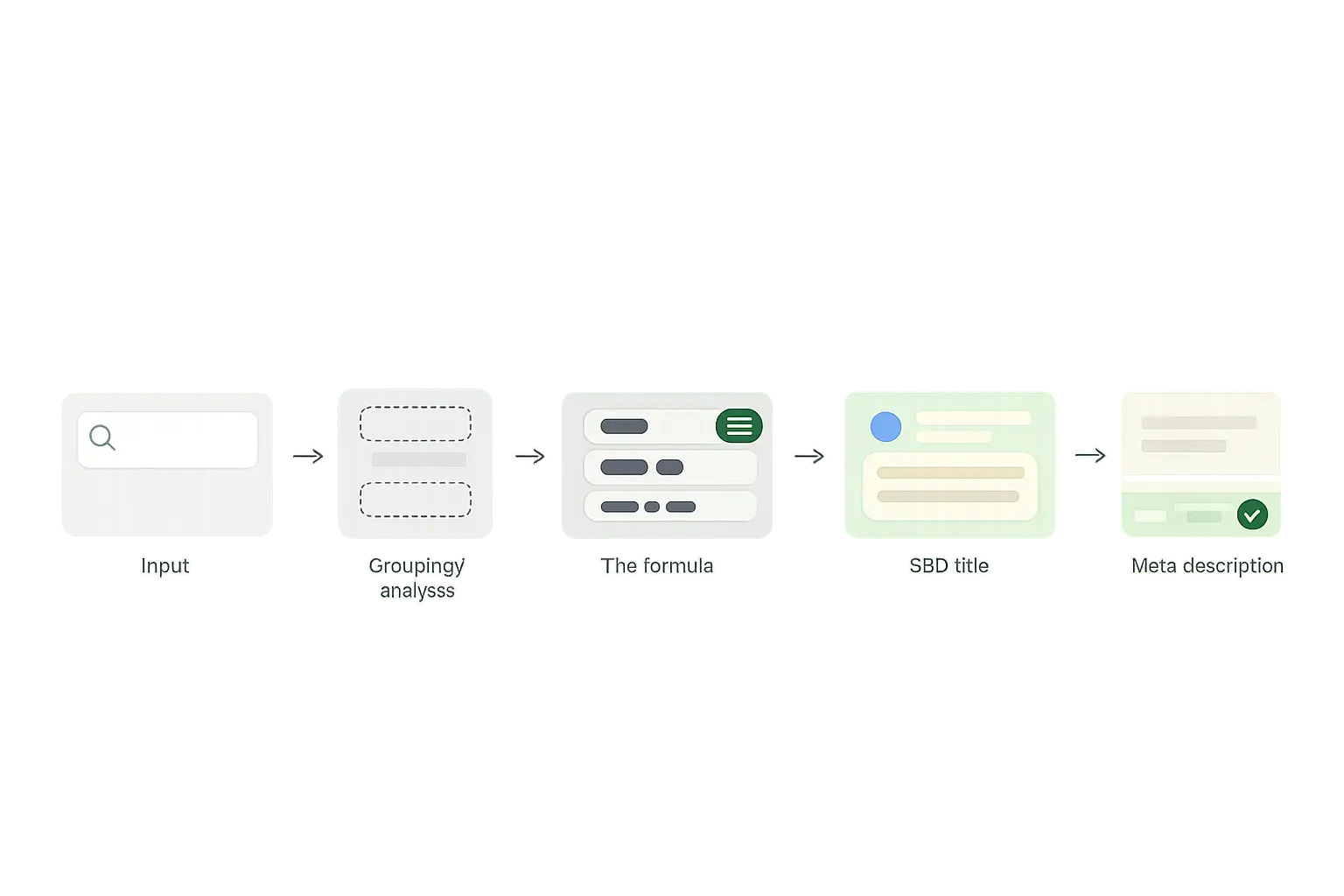
Step 1: Start with the primary keyword and supporting variations
Begin with the main phrase you want to target. In this case, that is seo title templates for bloggers. Then collect related variations such as SEO title formulas, blog title examples, headline templates, and SEO-friendly blog titles.
Step 2: Define the article angle
Decide what the post is really offering. Is it a list of templates, a tutorial, a beginner guide, or a set of examples?
Step 3: Draft multiple headline options
- SEO Title Templates for Bloggers: 17 Reusable Formulas
- How to Use SEO Title Templates to Write Better Blog Headlines
- Best SEO Title Templates for Bloggers and Content Creators
- 25 Blog Title Formulas for Better SEO and More Clicks
Step 4: Prioritize clarity over clever phrasing
A title should be understandable in seconds. Cleverness is fine when it supports clarity. It is useless when it hides the topic.
Step 5: Remove filler and weak modifiers
Trim unnecessary words that do not add meaning. Keep the keyword, the angle, and the benefit.
Step 6: Align the title, meta description, and slug
A strong SEO title works better when the meta description and URL slug support the same core topic. This creates a cleaner search result and a more coherent page entity for users, search engines, and AI-driven retrieval systems.
Examples of SEO Title Templates for Bloggers
- 12 SEO Title Templates for Bloggers to Use on Every Post
- How to Build Better Blog Headlines with SEO Title Templates
- Best SEO Title Formulas for Bloggers Targeting Informational Keywords
- SEO Blog Title Examples: Reusable Templates That Improve Clicks
- 7 Blog Title Template Mistakes That Weaken Your SEO
- Blog Headline Formulas That Help You Write Faster and Rank Better
These examples help cover long-tail phrasing while staying tightly aligned with the main topic. That matters not just for classic SEO, but also for LLMO and GEO, where semantic clarity, intent alignment, and direct answerability improve retrieval and citation potential.
Common Mistakes When Using SEO Title Templates
Using the same template for every article
Templates are useful, but repetition without variation makes a blog look formulaic.
Forcing exact-match keywords unnaturally
A keyword should fit naturally into the title. If the headline sounds awkward, click-through rate may suffer even if the phrase is technically included.
Writing titles that overpromise
If the content is a practical list, do not frame it like a revolutionary framework that will bend the laws of search themselves.
Ignoring snippet optimization
The title is only one part of the search result. If the meta description and slug are weak, the snippet becomes less persuasive.
Optimizing for rankings but not for clicks
A title can be relevant and still fail. Strong blog SEO titles need both keyword alignment and user-level value.
Try It with the Tool: Use SEO Snapshot to Generate Better Titles, Descriptions, and Slugs
If you already have a topic, a draft post, or a rough working headline, SEO Snapshot helps turn that input into cleaner search assets faster. Instead of manually rewriting a title, then a meta description, then a summary, then a slug, you can generate concise versions from the same content idea in one workflow.
- Generate multiple SEO title variations from a single article concept.
- Create concise meta descriptions that match the title and intent.
- Produce cleaner URL slugs for blog posts.
- Build multilingual search snippets more efficiently.
- Turn rough content drafts into clearer, more indexable metadata.
For bloggers and content teams, this makes the workflow faster and more consistent. You can test several title directions, keep the strongest one, and generate supporting snippet elements without turning your editorial process into ritualized suffering.
FAQ: SEO Title Templates for Bloggers
What is the best SEO title formula for a blog post?
The best formula depends on search intent and content type. For informational blog posts, “How to,” numbered list, and examples-based templates usually work well because they clearly communicate value and structure.
Do SEO title templates help rankings?
They can help indirectly by improving keyword relevance, title clarity, and click-through rate. A template does not guarantee rankings, but it gives you a stronger structure for creating optimized titles consistently.
Should every blog post use the exact target keyword in the title?
No. The primary keyword should be used naturally when possible, but semantic variations and closely related phrasing can also work well. Forced exact matches often make titles worse.
How many title options should bloggers create per post?
Creating three to five title options is usually enough. This gives you room to compare clarity, keyword use, and click appeal before choosing the final version.
Can one tool generate SEO titles, meta descriptions, and slugs together?
Yes. That is one of the practical advantages of using a workflow tool like SEO Snapshot, especially when you want concise outputs and multilingual support from the same content source.
Conclusion
SEO title templates for bloggers are not shortcuts for lazy writing. They are frameworks for writing better titles faster and more consistently. When used well, they help bloggers create headlines that match search intent, improve snippet quality, support topical relevance, and make the value of a post obvious.
The most effective approach is simple: choose a template that fits the article type, adapt it to the audience and keyword, and keep the wording clear. Then support that title with a strong meta description, a clean slug, and a concise summary.
If you want to streamline that process, SEO Snapshot can help you turn rough content ideas into sharper titles, summaries, descriptions, and URL slugs with less friction and more consistency.